Il s’agit d’un incroyable scandale financier:l’entreprise TEPCO est cliniquement morte et maintenue en vie artificiellement ,grâce à la complicité des politiciens corrompus de Tokyo.Voici:
Le 23/04/2014, Tepco a annoncé avoir reçu le soutien financier de la 27e dommages nucléaires Fonds de facilitation responsabilité.
La valeur du support est ¥ 191 800 000 000. Ils ont reçu 3.687.000.000.000 yen de soutien financier de ce fonds et ¥ 120 000 000 000 de compensation conformément à la «Loi sur le contrat d’indemnisation de réparation des dommages nucléaires».
Tepco indique le total de l’aide financière que Tepco a reçu jusqu’à présent n’est pas suffisant pour couvrir les paiements d’indemnisation jusqu’à la fin de mai 2014.
(26 milliards d’euro = 3,7 trillions de yens japonais)
L’annonce à la presse est ci-dessous.
Communiqué de presse (avril 23,2014) soutien financier du Fonds de la responsabilité de la facilitation des dommages nucléaires
Aujourd’hui, nous avons reçu ¥ 191 800 000 000 du Fonds de facilitation responsabilité de dommages nucléaires (ci-après le Fonds) sur la base du plan révisé spécial d’affaires (New Business Plan complet spécial) approuvé le 15 Janvier 2014.
Ce soutien financier a été donné en réponse à la demande 27 faite afin de couvrir les paiements d’indemnisation jusqu’à la fin du mois de mai 2014, comme étant la somme de la rémunération reçue conformément à la «Loi sur le contrat d’indemnisation de réparation des dommages nucléaires» ( ¥ 120 000 000 000) et le soutien financier apporté par le Fonds (3,6870 milliards de yens) ne sera pas suffisant pour la quantité de paiements jugée nécessaire à ce moment.
Avec le soutien financier reçu du Fonds, nous continuerons tous nos efforts dans la mise en œuvre des «paiements de compensation avec courtoisie et compassion » en considération de ceux qui sont atteints par le dommage nucléaire.
Students walk near a geiger counter, measuring a radiation level of 0.12 microsievert per hour, at Omika Elementary School, located about 21 km (13 miles) from the tsunami-crippled Fukushima Daiichi nuclear power plant, in Minamisoma, Fukushima prefecture.
Katsutaka Idogawa, former mayor of Futaba, a town near the disabled Fukushima nuclear plant, is warning his country that radiation contamination is affecting Japan’s greatest treasure – its children.
Asked about government plans to relocate the people of Fatuba to the city of Iwaki, inside the Fukushima prefecture, Idogawa criticized the move as a “violation of human rights.”
Compared with Chernobyl, radiation levels around Fukushima “are four times higher,” he told RT’s Sophie Shevardnadze, adding that “it’s too early for people to come back to Fukushima prefecture.”
“It is by no means safe, no matter what the government says.”
Idogawa alleges that the government has started programs to return people to their towns despite the danger of radiation.
“Fukushima Prefecture has launched the Come Home campaign. In many cases, evacuees are forced to return. [the former mayor produced a map of Fukushima Prefecture that showed that air contamination decreased a little, but soil contamination remains the same.] »
According to Idogawa there are about two million people residing in the prefecture who are reporting“all sorts of medical issues,” but the government insists these conditions are unrelated to the Fukushima accident. Idogawa wants their denial in writing.
“I demanded that the authorities substantiate their claim in writing but they ignored my request.”
Once again, Idogawa alludes to the nuclear tragedy that hit Ukraine on April 26, 1986, pleading that the Japanese people “never forget Chernobyl.” Yet few people seem to be heeding the former government official’s warning.
“They believe what the government says, while in reality radiation is still there. This is killing children. They die of heart conditions, asthma, leukemia, thyroiditis… Lots of kids are extremely exhausted after school; others are simply unable to attend PE classes. But the authorities still hide the truth from us, and I don’t know why. Don’t they have children of their own? It hurts so much to know they can’t protect our children.
“They say Fukushima Prefecture is safe, and that’s why nobody’s working to evacuate children, move them elsewhere. We’re not even allowed to discuss this.”
The former mayor found it ironic that when discussing the Tokyo Olympics, scheduled for 2020, Prime Minister Abe frequently mentions the Japanese word, “omotenashi,” which literally means that you should “treat people with an open heart.”
In Idogawa’s opinion, the same treatment does not apply equally to the people most intimately connected with Fukushima: the workers involved in the cleanup operations.
“Their equipment was getting worse; preparation was getting worse. So people had to think about their safety first. That’s why those who understood the real danger of radiation began to quit. Now we have unprofessional people working there.
They don’t really understand what they’re doing. That’s the kind of people who use the wrong pump, who make mistakes like that.
“I’m really ashamed for my country, but I have to speak the truth for the sake of keeping our planet clean in the future.
Idogawa then made some parallels with one of the most tragic events in the history of Japan: the use of atomic bombs on the industrial cities of Hiroshima and Nagasaki by the United States at the end of World War II.
“The authorities lied to everyone (about the effects of the atomic bombings)…They hid the truth. That’s the situation we are living in. It’s not just Fukushima. Japan has some dark history. This is a sort of a sacrifice to the past.”
When pressed on the details of a United Nations report that says there have been no radiation-related deaths or acute diseases observed among the workers and general public, Idogawa dismisses it as“completely false,” before providing some of his own experiences at the height of the crisis.
“When I was mayor, I knew many people who died from heart attacks, and then there were many people in Fukushima who died suddenly, even among young people. It’s a real shame that the authorities hide the truth from the whole world, from the UN. We need to admit that actually many people are dying. We are not allowed to say that but TEPCO employees also are dying. But they keep mum about it.”
When asked to provide solid figures on the actual number of people who died under such circumstances, Idogawa refrained, saying “it’s not just one or two people. We’re talking about ten to twenty people who died this way.”
Asked about other options that Japan has for providing energy sources to its 126 million people, he responded that despite having many rivers, the government neglects to promote hydro energy.
Why? Because it’s not “profitable for big companies!”
Idogawa goes on to provide a blueprint for fulfilling Japan’s energy needs that sounds surprisingly simple.
“We can provide electricity for a large number of people even with limited investment, without taxes. Just use gravity, and we may have so much energy that there’ll be no need for nuclear plants anymore.”
Premonitions of disaster
Even before the massive failure at the Fukushima nuclear power plant on March 11, 2011, the day northeastern Japan was hit by an earthquake-triggered tsunami that caused the meltdown of three of the plant’s six nuclear reactors, Idogawa knew the facility was dangerous.
“I asked them about potential accidents at a nuclear power plant, pretending I didn’t know anything about it, and it turned out they were unable to answer many of my questions,” he said. “Frankly, that’s when it first crossed my mind that their management didn’t have a contingency plan. It was then that I realized the facility could be dangerous.”
The former mayor, who happened to be in a nearby town on the day the tsunami struck, recalled driving back to Futaba upon news of the earthquake. Only later did he discover how close he came to losing his life in the approaching tsunami. “I managed to get there before the bigger tsunami came. It was only later that I realized that I escaped the water… I got lucky. The tsunami came after I drove off that road and up the mountains.”
Members of the media and Tokyo Electric Power Co. (TEPCO) employees wearing protective suits and masks walk toward the No. 1 reactor building at the tsunami-crippled TEPCO’s Fukushima Daiichi nuclear power plant in Fukushima prefecture March 10, 2014.
Questions regarding the nuclear power plant dominated his thoughts on the 30-minute drive home. “I just kept thinking, ‘If it’s that strong, what will happen to the power plant? What if the reactor is damaged? What if the water leaks? What will the city do? What am I to do as mayor?’ »
Once in his office, Idogawa looked out the window and was confronted by what he described as “a terrifying sight.” “Usually you couldn’t see the sea from there, but that time I could see it just 300-500m away,” he said.
It was at that point that the mayor realized that the nuclear power plant had probably suffered some sort of damage. After spending the night watching news reports on television, the only source of information since even mobile phones were not working, Idogawa announced an emergency evacuation early the next morning. Not all of the residents, however, heard the emergency broadcast.
“Later, I learned that not all Futaba residents heard my announcement. I feel guilty about that…I found out that the Fukushima prefecture hadn’t given me all the information in a timely fashion. And now the government isn’t taking any steps to ensure people’s safety from radiation, and isn’t monitoring the implementation of evacuation procedures.”
Beyond nuclear energy
Katsutaka Idogawa believes a transformation to a cleaner, safer form of energy source for Japan would require a willingness to change the country’s laws.
“There are many laws in Japan, perhaps too many. There are laws about rivers and the ways they’re used. We could change laws regarding agricultural water use and start using rivers to produce electricity. Changing just this law alone will allow us to produce a lot of energy.”
All of this could be accomplished “without contaminating our planet.”
However, such bold proposals do not “appeal to big companies, because you don’t need big investments, you don’t need to build big power plants. It’s not that profitable for investors, for capitalists.”
But for the former mayor of a devastated Japanese town, lost to nuclear radiation, Idogawa senses a sea change forming in public opinion.
The Japanese people are beginning to “realize that we need to avert nuclear disasters, so 60-70 percent of the population is in favor of using natural energy.”
“It took us a long time, but one day we’ll follow the example of Europe, of Germany.”
Un vidéo à voir :il sera la première partie de nombreux articles que j’ai commencé à écrire sur le sujet…dont la formule de drake,les messages envoyés…et reçus de l’espace!
…À suivre mes ami(e)s!/
A video to see: it will be the first part of many articles that I started to write about … whose formula drake, messages sent and received … from space!
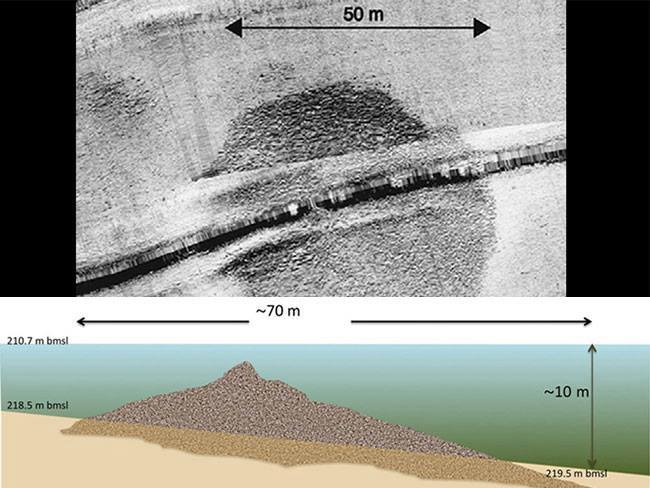
This past summer, Archaeologists in Israel discovered an enormous structure under the Sea of Galilee.
A huge, cone-shaped monument has been discovered by a team of Israeli archaeologists conducting a geophysical survey on the southern Sea of Galilee.
« According to a paper published in the International Journal of Nautical Archaeology, the structure was built several thousand years ago and later submerged under the water.
It is 230 feet (70 m) in diameter and about 39 feet (12 m) high. The estimated weight of the monument is over 60,000 tons.
“The site resembles early burial sites in Europe and was likely built in the early Bronze Age. There may be a connection to the nearby ancient city of Beit Yerah, the largest and most fortified city in the area,” explained Dr Yitzhak Paz from Ben-Gurion University, lead author of the paper reporting the discovery.
“The stones, which comprise the structure, were probably brought from more than a mile away and arranged according to a specific construction plan,” added co-author Prof Shmuel Marco from Tel Aviv University. »
America’s National Guard is following a direct order — but it does not seem very happy about it. All of the National Guard’s AH-64 Apache helicopters are scheduled to go to the active Army, and there’s nothing its top brass can do about it.
“None of us like what we’re having to do,” National Guard Chief Gen. Frank Grass told members of the Senate Armed Services Committee on Tuesday, the military website Defense One reported. “My big concern right now is figuring out how I’m going to move, and how many states I’m going to have an impact on, and what’s the cost of facilities and to retrain pilots. I’ve got to tackle that because the decision’s been made.”
Disguised as budget cuts, Army Chief of Staff Gen. Ray Odierno told members of Congress on Tuesday that the move will save $12 billion through fiscal year 2017, Defense One reported.
Informations coming from the Colonel Riley …with his permission.
Starting Tuesday morning, members of both houses ofCongress began receiving copies of documents demanding the resignations of six top government officials for violating their oath of office from members of Operation American Spring, the group said in a press release emailed to Examiner.com Wednesday.
The documents also include articles of impeachmentagainst President Obama for what the group calls high crimes against the state.
« This bold move is only the second time in our nation’s rich history such a demand has been made to relieve our oppressed and abused people from an egalitarian, corrupt, and unresponsive regime, » the group said.
The group also said Americans have only two options: Either « surrender to totalitarian rule by Marxist ideologues, or enforce our American ideals and principles. »
Operation American Spring said that it envisions 10 to 20 million Americans committed to reforming the government, and, according to a group spokesperson, may meet or exceed that goal.
OAS says it is modeled after the Arab Spring that saw regime change in Egypt, along with other successful, popular, and massive demonstrations against oppressive bureaucracies.
« And in the face of those who claim that even if those numbers are achieved, there is no way our corrupt leadership will comply with the People’s demands—one only has to witness the Arab and Ukrainian movements—where they turned out their corrupt and incompetent usurpers without the benefit of Constitutional validation, » OAS added.
The goal, according to retired Col Harry Riley, is the removal of President Obama, Vice President Biden, Senate Majority Leader Harry Reid, D-Nev, Senate Minority Leader Mitch McConnell, R-Ky., House Speaker John Boehner, R-Ohio and California Democrat Nancy Pelosi, the House Minority Leader.
Col. Riley said the protest — set to begin on May 16 — operates under six main assumptions:
Millions of Americans will participate.
American veterans and patriots are energized to end the tyranny, lawlessness, and shredding of the US Constitution.
Government is not the target, it is sound; corrupt and criminal leadership must be removed.
Those in power will not hesitate to use force against unarmed patriots exercising their constitutional rights.
Patriots may be killed, wounded, incarcerated.
There is no hope given today’s technology of secrecy for the effort nor do we want it secret.
OAS said there is one thing no one can deny: « The People outnumber their administrators, and regardless how much control the ones at the top seize, they always fall—always have, always will. »
« It only matters how much pain they are willing to inflict on the People, and how much pain our ‘leaders’ are willing to bear themselves, before they collapse, » OAS concluded.
C’était ce mercredi 2 avril 2014 sur le plateau de Jimmy Kimmet Live.
L’ancien président des Etats-Unis a rapporté en direct à la télévision que le seul moyen d’atteindre une paix mondiale serait une attaque par des extraterrestres belliqueux. Est-ce que quelque part ,on n’est pas en train de nous prévenir ou de chercher à nous faire peur …d’avance?
Le présentateur Jimmy Kimmel décida de mettre les projecteurs sur Bill Clinton en lui posant des questions qui sont restées à l’esprit du public depuis toujours… à propos des extraterrestres. Et il a répondu qu’il avait fait des investigations sur la Zone 51, mais avait découvert qu’aucun alien n’était détenu là bas. L’ex-Président a aussi ajouté qu’il y avait beaucoup de chances que nous ne soyions pas seuls dans l’univers. Jimmy Kimmel a sursauté et s’est exclamé: « Oh, vous essayez de nous donner un indice sur le fait qu’il y a vraiment une vie extraterrestre ?! » A ce moment là, Bill Clinton panique et dit rapidement: « non ». Inquiété d’avoir peut être rompu son serment de garder tout cela secret, il a poursuivi ensuite en faisant référence à ce qui avait déjà été exprimé par le Président Ronald Reagan lors d’un discours à l’ONU: « Peut être que c’est la seule manière de nous unifier dans ce monde incroyablement divisé qu’est le nôtre. Les gens ne pointeraient plus du doigt leurs différences si nous nous sentions menacés par des envahisseurs de l’espace. C’est tout le thème du film Independance Day », a-t-il dit.
Ukrainian scientist has discovered the oldest pyramid in the world. What is most interesting is that it was discovered in the most beautiful part of the country, in the Crimea. Such as the ICTV channel reported the discovery was revealed by accident, because the Ukrainian scientific Vitalii Goh discovered an unknown underground object when testing alternative methods of finding water, which proved be a pyramid 45 meters high and 72 meters long, according Aliye Beki.
According to Goh Vitalii the pyramid was built in the time of dinosaurs. « The Crimean pyramid » has a truncated summit, as a Maya pyramid, but its appearance is rather Egyptian . It is hollow inside and the mummy of an unknown creature is buried under the foundation. « Under the foundation is a small body in the form of a mummy from 1.3 to 1.4 meters long with a crown on his head . » » There is a resonance chamber so-called Sphinx. The pyramids were built at the time of the dinosaurs, » the scientist said in an interview with ICTV . We do not know who built the pyramid know . Vitalii Goh reported to Beki that this is the only the oldest building in the world .
A state of emergency has been declared in the Marshall Islands following severe floods that have swamped the low lying atolls.
Almost a thousand people have been displaced in the capital of Majuro, with another 246 evacuated in the separate island of Arno, according to UN figures. Four evacuation centres have been set up in schools and churches in Majuro.
Exceptionally high tides, known locally as King tides, rose across Majuro on Monday, damaging buildings and infrastructure along the shoreline.
Tony de Brum, the minister-in-assistance to the President of the Marshall Islands, told RTCC that the frequency and intensity of the high tides are increasing, which means those who live close to the shoreline may have to consider more permanent displacement.
“I’m talking about a short term solution to a long term problem,” he said. “Perhaps we can find a way to make more permanent moves for people who are already much too close to the shoreline.”
The Government established an Emergency Operations Centre yesterday, according to the UN, and has been holding National Disaster Committee meetings with humanitarian partners, including Red Cross and the International Organisation for Migration, which are already providing aid in the country.
The Marshall Islands are comprised of 29 atolls which lie at an average of two metres above sea level, making them vulnerable to the effects of climate change.
Parts of the islands lie just 30cm above water, and a sea level rise of 80 cm would inundate two-thirds of the islands, according to projections. This is a scenario which could occur by the end of the century, according to the UN’s climate science body, the IPCC.
Migration
Any relocation will be within the islands themselves, said de Brum – the idea of leaving the Marshall Islands remains “repugnant” to islanders, and could be counterproductive in diminishing the imperative to stop polluting.
Currently, people form the outer islands are flowing towards the capital of Majuro, where there are schools, hospitals and economic opportunities, as disappearing shorelines cause their own atolls to become uninhabitable. Between 2006 and 2011, migrants from other islands to Majuro numbered 1,772.
But even moving within the islands is difficult, says de Brum, meaning many residents are becoming increasingly concerned about what the future holds as the climate changes.
“Because people from the other islands will have to rebuild, relocate, and work out the arrangements for financing or for assistance or for land access from the people of Majuro, they’re becoming a lot more concerned about climate change than they’ve ever been before,” he said
Meanwhile, he said, people who already live in Majuro are worried about how they will find the space to accommodate more people as the island itself shrinks. He said: “There’s less land throughout the atoll for the accommodation of our friends and neighbours from the other islands.”
Paris treaty
While high tides are expected at this time of the year in the Marshall Islands, de Brum stresses that “this is far from normal”. On parts of the island, water from the lagoon and the ocean sides have risen so far they had met in the middle – something he hadn’t seen since 1979.
With their vulnerability to sea level rise, the Marshall Islands and their neighbouring countries are some of the most ambitious when it comes to pushing for a strong climate change agreement at the UN – a treaty that is expected to be signed off in Paris in 2015.
Last year, the Pacific Small Island States signed a “Majuro Declaration” designed to rally action on climate change – a movement which de Brum says is “gaining momentum” with small and large countries, including Japan and Mexico, signing on.
Although no single extreme weather event can be attributed to climate change, the intensity and frequency of such occurrences are expected to increase this century, and the current floods indicate the threat that they will pose to the islands.
This is something de Brum hopes will help to make their case at the international summits where the future climate treaty is discussed. “High tides speak louder than words and this is yet another example,” he says.
“It presents an opportunity for us whenever we have these king tides for us to refocus attention on what many people don’t realise: that this is a now issue, not a future issue.”









 Michelduchaine